
Washington Parole and Probation Differences
Parole, probation, post-release supervision, and earned-release supervision are distinct Mississippi statuses. Parole is conditional release from an MDOC sentence after action under the state parole framework. Probation usually follows a court order that suspends or structures a sentence. Post-release supervision comes from the sentencing framework. Earned-release supervision, often shortened to ERS, is tied to the earned-time law in Miss. Code § 47-5-138. All four may place a person outside a jail or prison while conditions and the risk of revocation continue.
The source of the status matters. The Mississippi State Parole Board handles parole decisions. MDOC Community Corrections supervises people in the community, including parolees, probationers, and people on ERS. A Washington County court record can show a probation order or sentence term, while an MDOC record may point to parole or another community placement. Neither source alone fixes the exact moment the person walked out of the Washington County Regional Correctional Facility.
| Status | How it begins | Best verification source |
|---|---|---|
| Parole | Conditional release under parole law and board authority | MDOC record, parole action, and Community Corrections |
| Probation | Court disposition or suspended sentence | Sentencing court order and Community Corrections |
| Post-release supervision | Term imposed through the sentence | Court judgment, MDOC record, and local office |
| Earned-release supervision | Conditional release under the state earned-time statute | MDOC record and Community Corrections |
These distinctions prevent a common error. Being outside the facility does not always mean the sentence is discharged. Discharge is the end of the applicable sentence or supervision term. A person on ERS remains under MDOC jurisdiction and retains inmate status until the sentence expires.
- Supervision
- Legal oversight in the community under stated conditions.
- Discharge
- Documented completion of a sentence or supervision term.
- Revocation
- A formal process that may end community placement and return a person to custody.
- Absconder
- A person alleged to have stopped reporting or complying with supervision.
Verify Washington Post-Release Supervision
No dedicated official statewide public probation or parole lookup was verified in the research sweep. No public Washington County active-case list was found either. Verification therefore needs more than a broad name search. Begin with the official MDOC inmate search when the person has an MDOC number or served a state sentence. Match the MDOC number and date of birth before relying on a location or status. A common name is not enough.
Follow a short evidence chain. It separates identity, physical release, supervision, and discharge instead of blending them into one claim.
- Confirm the person with the full name, MDOC number, date of birth, and the relevant Washington County booking or case number.
- Read the MDOC Location, Unit, Location Change Date, and sentence fields exactly as shown. Do not translate an unclear location into community release.
- Call the Washington Probation & Parole Office and ask which public channel can confirm current supervision and office assignment.
- Check the Washington County court system for the judgment, probation order, parole-related filing, revocation order, or order ending supervision.
- Use the sheriff or facility release entry when the question is the actual departure from confinement, then seek a discharge record if the question is whether control ended.
The local office may protect residence details, schedules, victim information, case notes, and operational facts. Ask for a public status or the right records custodian. Do not ask staff to disclose a whole case file by phone. For the complete county search and release-record path, use the Washington County released inmates lookup.
Important: A local supervision assignment confirms a community-corrections relationship. It does not prove the date or type of physical release from the regional facility.
Washington Supervision Office Details
The official local human-verification channel is the Washington Probation & Parole Office in Greenville. MDOC names Tony P. Harris as Community Corrections Director. The page does not publish counter hours, person-level online results, reporting instructions, or an active-case list. Call before visiting. Use only a verified office channel when an inquiry requires an identifier.
Washington Probation & Parole Office
819 Rear Main Street, Suite C
Main Place Office Complex
Greenville, MS 38701
Mail: PO Box 40
Phone: 662-332-1975
Fax: 662-332-7091
Hours: Not published; call first
The office page is also useful for checking agency identity before sending any information. The official MDOC office listing shows the local contact details pictured below.
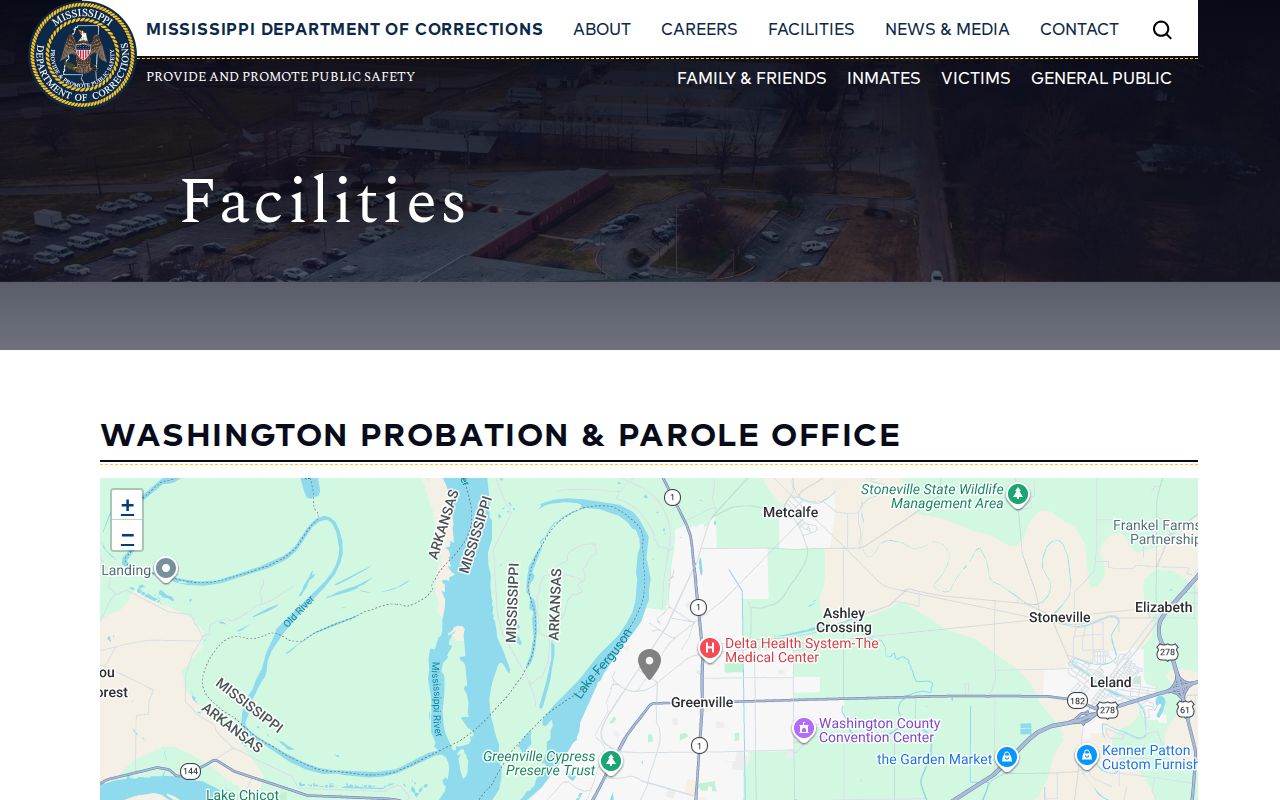
The image confirms the office and contact route, but it is not a public supervision roster. Staff can route a status inquiry without publishing protected case details.
When the MDOC record suggests a community placement, provide the MDOC number and ask whether the Greenville office is responsible. If another office holds the case, request routing information. A supervision office answer should still be paired with the court record when the legal basis matters and with the jail entry when the physical exit date matters.
Washington Absconder and Warrant Checks
No official MDOC public absconder database or Washington County Community Corrections absconder list was verified. That narrow finding does not mean a warrant cannot exist or that Mississippi keeps no internal supervision record. An alleged absconder status normally signals a claimed failure to report or comply. It may lead to a warrant or revocation process, but it does not show by itself that the person was arrested again, booked in Washington County, or returned to prison. The reverse is also possible. A person may be detained on an alleged violation before a public MDOC field changes. Use the local office, MDOC, the court custodian, and the relevant law-enforcement office, and record the date and issuing authority for each claim.
Mississippi SAVIN lists automated events that can include return to custody and escape or abscond supervision. A notice is a lead tied to the reporting agency. A transfer notice does not mean community release, and an automated event does not replace a warrant, court order, revocation decision, or discharge record. If several notices arrive close together, confirm the sequence with the agency named in them.
Conditions vary by order and status. At a high level, supervision requires compliance with the controlling terms and contact with the assigned authority. A claimed violation is not the same as a final revocation. Revocation is the formal action that can return someone to confinement. Ask for the dated order rather than relying on rumor or an undated status.
Note: A missing online absconder result proves neither compliance nor the absence of a warrant; use the named agency and dated official record.
Washington Regional Reentry Path
Washington County Regional Correctional Facility has a mixed legal population. The sheriff controls daily operations, while MDOC oversees the state-inmate part of the regional partnership. MDOC says regional facilities provide educational, vocational, treatment, faith-based, and reentry programming. It does not promise that each person receives a set service or achieves a stated outcome.
This local structure affects supervision checks. A local detainee may leave after bond, a court order, or completion of a county matter without ever becoming an MDOC prisoner. A state inmate housed in the same building may move to another MDOC site, enter parole or ERS, or later discharge. Leaving the Greenville building can therefore mean transfer, community release with supervision, or complete discharge. The authority and destination fields decide which description fits.
When the record points to parole, probation, post-release supervision, or ERS, the Washington office is the local contact. When it points to another institution, contact that custodian. For a local court disposition, obtain the order and the sheriff or facility departure entry. This custody-first method is more reliable than assuming every released person from the regional facility follows the same path.
Washington Release Property Questions
No official page reviewed publishes a property-return, identity-document, or release-record correction process for Washington County Regional Correctional Facility. No public turnaround is stated. The supported route is to call facility administration at 662-537-2000 and ask which office handles the issue. Tie the inquiry to the correct booking identifier and date so staff can distinguish separate custody episodes.
For a factual error, name the field and the source document that supports the correction. For property, ask whether the facility has a recorded inventory, pickup rule, or authorized recipient process. Do not assume the probation and parole office holds property from the jail. Community Corrections handles supervision, while facility administration or the sheriff controls the local custody record and related operational questions.
Identity issues can also affect a supervision check. Compare the booked name, aliases, date of birth, MDOC number, booking number, and court case number. If two records conflict, preserve each agency’s exact label and date. Ask the originating office to correct its own record rather than asking one agency to amend another agency’s system.
Note: The facility has not published a property or correction workflow, so confirm the responsible office and current requirements before sending documents.
Washington Supervision Discharge Records
Supervision ends only when the controlling authority records that result. A completed jail release does not by itself show that parole, probation, post-release supervision, or ERS ended. For probation, inspect the court order and any later order terminating the term. For parole or another MDOC status, ask for the state record that shows the end of jurisdiction. Use “discharged” only when the evidence supports full completion.
ERS requires extra care. Under § 47-5-138, a person released before sentence expiration remains under MDOC jurisdiction and retains inmate status until the term expires. If ERS is revoked, the statute calls for service of the remainder, and time spent on ERS does not reduce the sentence. A community address or an out-of-custody notice therefore does not establish discharge.
Build the final finding from three questions. Did the person physically leave the facility? Was the event a community release or a transfer? If it was a community release, did supervision continue or did the sentence fully end? The facility entry answers the first question. Destination data helps with the second. MDOC, Community Corrections, and the court record resolve the third. The Washington County Sheriff page confirms that a jail docket is kept. Keep the dates and agencies attached to every answer.