
Washington Projected and Actual Release Dates
MDOC labels the public state-record field “Tentative Release Date.” The older printable system uses “Tentative Release.” Both labels describe a computation snapshot, not a certificate that the person left custody. The MDOC Inmate Handbook says the department computes several distinct dates, including parole dates, earned-release-supervision dates, tentative release or discharge dates, and maximum release dates. Copy the label that appears rather than calling every date final.
An actual release date records an event that occurred. The event also needs a type and destination. A person can leave Washington County Regional Correctional Facility for another institution, which is a transfer rather than release to the community. Someone who enters earned-release supervision has left confinement but remains under MDOC jurisdiction. Full discharge is a stronger result and needs its own record.
Scheduled vs actual: A future date is a projection. A past projected date still does not prove that departure occurred on that day.
Pretrial custody works differently. A local detainee has not yet received a final sentence computation. Bond, a court order, dismissal, another hold, or later sentencing can control the next event. Ask the facility for the last custody entry and the court for the order. Do not apply a state earned-time formula to a person who never entered MDOC jurisdiction.
- Tentative release date
- MDOC's public estimate based on the current sentence computation.
- Parole eligibility
- The point when the law may allow consideration, not a grant or departure date.
- Earned-release supervision
- Conditional release from confinement while MDOC jurisdiction continues.
- Discharge
- The documented endpoint of the sentence or supervision term.
Find Washington Projected Release Dates
Start by classifying the custody. The Washington County Regional Correctional Facility can hold local detainees and MDOC prisoners in the same building. The correct search path turns on legal custody, not the street address. An MDOC number is the clearest sign to use the official state search. A county booking number or local case number points to the facility, sheriff, and court.
Use this sequence to locate and interpret the date without turning a search result into a promise.
- Confirm identity with the full name, date of birth, MDOC number, booking number, or court case number. Do not rely on a name alone.
- For an MDOC sentence, open the official MDOC inmate search and select the matching person.
- Record the exact Location, Unit, Location Change Date, sentence data, county of conviction, and Tentative Release Date, along with the access date.
- For a local Washington County matter, call the regional facility and review the sentencing or bond order through the proper court. Ask for the recorded release authority and date.
- Determine whether the displayed date concerns parole, ERS, tentative release or discharge, or the maximum endpoint. Confirm the actual event after the date passes.
The MDOC result does not prove that every person arrested in Washington County entered state custody. Likewise, a county record does not replace the state calculation for an MDOC prisoner housed regionally. When the physical exit from the Washington County facility is the key fact, obtain the local departure entry even if the state page shows a date.
The broader Washington County released inmate search explains the county jail-docket and court-record route when the person has already left the facility.
Washington Tentative Date Fields
The current MDOC detail schema gives more than a date. It includes the MDOC ID Number, photograph, date of birth, physical description, Entry Date, Location, Unit, Location Change Date, Number of Sentences, Total Length, offense, sentence length, county of conviction, sentence date, and Tentative Release Date. Read those fields together. A date without the location and sentence context is easy to misstate. A blank Tentative Release Date also occurs on official records. Blank does not mean discharged. It may reflect a life sentence, a data limit, or another circumstance the public page does not explain.
| MDOC field | Why it matters |
|---|---|
| MDOC ID Number | Separates people with similar names and ties the result to the state record. |
| Location and Unit | Shows the reported placement that must be read with the date. |
| Location Change Date | Dates a reported movement but does not by itself classify it as release. |
| Sentence fields | Provide length, offense, sentence date, and county context for the computation. |
| Tentative Release Date | Shows the current public projection, which can change. |
Contact MDOC for the current record instead of guessing why a field is empty. The location and sentence fields also help prevent a tentative date from being mistaken for proof of current community release.
The official MDOC detail-page sample shows the field layout used in the screenshot below. It is cited only to document the interface, not to profile the individual displayed.
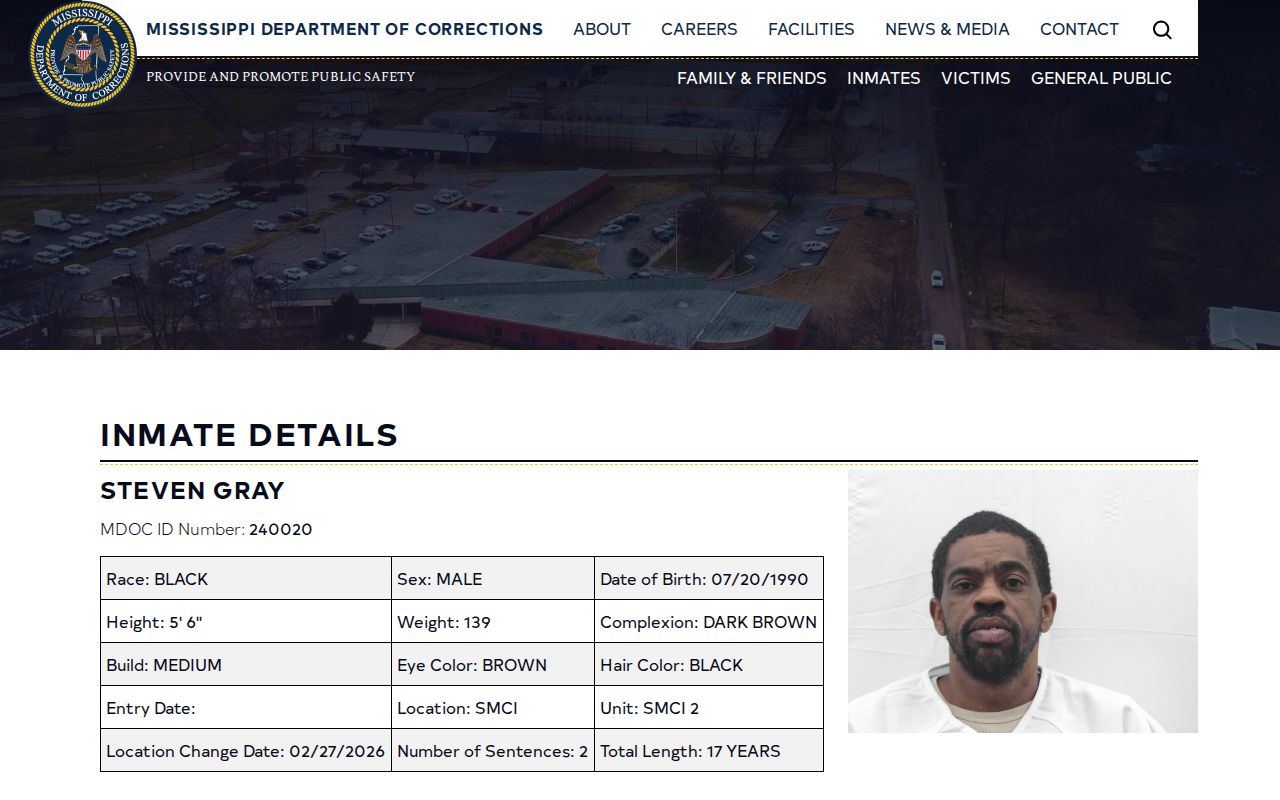
The image places the tentative date beside identity, location, and sentence information. Those nearby fields are essential when deciding whether the result describes current confinement, movement, community supervision, or a projected endpoint. MDOC's legacy printable record adds a direct warning that state law can cause release types and dates to differ from website information. Treat the public page as a lookup lead. Ask MDOC for existing discharge or release documentation when a conclusive historical date is needed.
Washington Earned-Time Calculations
Miss. Code § 47-5-138 supplies the central state earned-time rule. For a sentence imposed after June 30, 1995, subsection (5) authorizes 4.5 earned days for each 30 days served when MDOC determines that conduct and performance requirements were met. The allowance cannot exceed 15 percent of the sentence. A full 15 percent reduction leaves 85 percent, which is the source of the common “85 percent” shorthand.
That shorthand is not a universal release warranty. Eligibility, MDOC's conduct determination, forfeiture, statutory exclusions, sentence structure, corrected jail credit, detainers, parole law, and later court action can all affect the result. The handbook describes significant ERS limits for certain sentence and offense categories. It should be used as the source instead of turning a complex set of rules into a simple public eligibility test.
County-jail credit can also change an MDOC computation. The handbook says eligible pre-sentence or pretrial time must connect to the cause number and fall between the offense date and earliest sentence date. MDOC requests jail time from the county of conviction and uses allowable credit to set the sentence-begin date. A person transferred among jails may need the record from each site to resolve missing time. For a Washington County conviction, compare the sheriff's custody dates, court commitment papers, and the MDOC timesheet through the authorized correction process. Not every day in any jail automatically counts. The date range and cause number must fit the state rule, and MDOC makes the sentence computation.
Note: Earned time can affect an MDOC projection, but parole eligibility follows a separate legal framework and is not the same date.
Washington Release Date Changes
A tentative release date can move for more than one reason. Some changes arise within MDOC, while others come from a court or another custodian. Save the displayed date and access date. Then use the current official record when timing matters.
| Factor | Possible effect | Record to check |
|---|---|---|
| Earned-time loss or recalculation | Changes credit applied to the sentence | MDOC computation and disciplinary record where releasable |
| County-jail credit correction | Moves the sentence-begin calculation | Jail custody dates, commitment papers, and MDOC timesheet |
| New or amended court order | Changes the sentence or legal authority | Dated judgment, amended sentence, or appellate order |
| Additional or consecutive sentence | Extends or restructures the aggregate term | Sentence records and MDOC calculation |
| Detainer or receiving-agency hold | Prevents community release even if one term reaches an endpoint | Destination and receiving-authority records |
| Parole or revocation action | Changes the path between confinement and supervision | Parole action, MDOC status, and court or revocation record |
A detainer is a request or notice from another authority that may affect what happens next. It can turn departure from one facility into transfer to another custodian. A future parole-eligibility date is only a chance for consideration under the law. It is not an approval, and an approval can still depend on conditions or other holds.
Subsections (6) and (7) of § 47-5-138 show why date changes and status labels must stay separate. A person released on ERS remains under MDOC jurisdiction until sentence expiration. If ERS is revoked, the person serves the remainder, and time on ERS does not reduce the sentence. The confinement date, supervision date, and full discharge date may therefore differ.
Washington Local Release Date Checks
No official Washington County-specific jail good-time policy, weekend-release rule, or local sentence formula was found on the pages reviewed. Do not apply § 47-5-138 mechanically to a local sentence that never entered MDOC custody. That statute governs the state earned-time framework. A county practice needs its own official source.
For a local detainee or county-sentence question, begin with Washington County Regional Correctional Facility at 662-537-2000. Ask whether the person is held under local authority or an MDOC number and which office maintains the date. The Washington County Sheriff says a jail docket is kept, so a narrow request can seek the recorded departure date, release authority, and destination. The Washington County court system can supply the judgment or later order that explains the legal basis.
A bond order may authorize release, but processing and another hold can delay departure. A dismissal may end one case while another jurisdiction retains custody. “Not in custody” says only that the responding agency no longer reports the person there. Ask for the last custody event and receiving authority before describing the result as release to the community.
Note: Washington County publishes no local calculation formula, so use the facility record and court order rather than an estimated date from another county.
Confirm Washington Actual Release Dates
After a projected date passes, check the system that controlled custody. For an MDOC prisoner, reopen the state record and ask for the existing release or discharge document when historical proof is needed. If a community status appears, the Washington Probation & Parole Office can help route a supervision inquiry. For a local detainee, seek the facility or sheriff departure entry and match it to the court order.
Mississippi SAVIN can report custody changes for MDOC offenders and people in participating county jails. A VINE notice may help track a pending event, but a missing result does not prove release. “Transfer” or “other custody” means legal custody may continue elsewhere. The VINE Inmate Check explains the person-specific search and notification steps.
The strongest confirmation chain uses the tentative field as a lead, the release or discharge record as proof of the state event, Community Corrections when supervision follows, and the Washington County departure entry when leaving the local building is the fact at issue. Keep each agency, field label, and date intact. That record trail distinguishes a forecast, a transfer, conditional community release, and final discharge.